Noi6 means "the 6 of us" in Romanian.

We are five, you are the sixth one.

We thank you for joining us in our trip around the world...

Showing posts with label China. Show all posts

Sunday, April 29, 2012

Videos

2 comments
So, I made a couple videos with the Hong Kong footage. The first one has a song by Roxette called "Fireworks" and it's about Hong Kong in general.


The second one has a song by Daisy Dares You called "Number One Enemy" and it's about the Chinese New Year parade.


Enjoy!

Wednesday, February 1, 2012

China (because this is SUCH an imaginative title)

0 comments
Oh thank God for China. I understand China. I know Chinese food. China makes sense. Not that I don't love India, no—but despite how much colder it is here, I love China much more.
We flew from Kochi, India, to Guilin, China, then took a taxi to Yangshuo, where we had a real fireplace and electric blankets. We hiked mountains, rode buses, and floated down rivers. Then from Yangshuo we went to Guangzhou, and all I remember from it is we went to see the museum of the tomb of King Nanyue, who was buried in a suit of jade during the Han Dynasty, and his tomb was discovered in 1983. It has colored frescoes in the funerary chamber and is larger than most tombs from the time. I also remember fighting with Maria because I'd taken a brochure for the museum in French, and instead of using Ultralingua (an English-to-French/French-to-English app), I'd ask Mom for translations and wouldn't let Maria read it. Well, I did, but more like "I am sitting here reading. You may read over my shoulder but if you remove this brochure from my hands there will be dire consequences *glares menacingly from corner of eye*." This part was actually written while consulting my pink French brochure.

Sunday, January 29, 2012

Southern China

0 comments

China is foggy. If we hadn't seen the blue sky at the Great Wall near Beijing, we probably would have left thinking China's sky is a nondescript gray color.

Which it is in most places.

It was also cold— I was wearing pantyhose, two pairs of leggings (thank God for India and punjabis), legwarmers, my short-sleeved shirt, and my long-sleeved shirt. On top of which I had my sarong on as a scarf (can't think why I didn't think of it before), my Scottevest, and my Marmot.

And gloves. And a hat. And my hood.

Not to mention socks.

And on top of this, if we weren't walking fast, I was still cold!


Saturday, January 28, 2012

Back to ...China

0 comments
Freedom is a perception. It is different for different people. I grew up in a communist country. As a child I thought I had freedom and I felt safe. The same militia that guarded my returning home from a concert at two o’clock in the morning in 1981, was preventing other people gathering to protest the communist rule in December 1989. In the following years I would change drastically my view of freedom and what it means for me.

As the sign for seat-belts is turned off I am relieved: I am out of China’s territory. Why this reaction? Personal protest. Leaving China last time was not a pleasant experience. They opened our bags looking for books (Lonely Planet guides are forbidden, as are Dalai Lama’s pictures). I would understand looking for them when we entered the country, but leaving? This would have been a forgettable incident if it would have come before Tibet. But not after seeing so many soldiers and SEAL troops like the Tibetans would live in a military fort and the way they treated them, less then human, watching them like an unpredictable animal. I wish that I could not judge. I reason: these are politics, the Chinese need the metals from Tibetan soil. But I can’t. History was one of my favorite subjects in school and I believe that many people died for my country to be free, to have the right to speak my language, to have the religion that I have. So it cost me a great effort to reason and not to react to the Tibetan cause.

Friday, January 27, 2012

Macao and A Card Game

1 comments
Macau is a different thing altogether. I still don't know in which language is Macau and in which is called Macao. My mother asked why do we stay two days, they had a few hours in the city and didn't really like it. When we were children we played all the time a cards game, called Macao. The fact that they have a country named after a cards game, or the other way around made us curious and we always wanted to come here. Half a million people live on a small peninsula and the two adjacent islands of Taipa and Coloane. It was a Portuguese colony until 1999 and now, along with Hong Kong is part of the China's one country-two systems scheme. The historic center of Macau is designated an UNESCO World Heritage Site. The reason is that it is a unique blend of western and eastern culture. The Portuguese arrived in early 1500s and stayed throughout the following centuries, being the forefront of the interaction between the two worlds.


Wednesday, January 25, 2012

Hong Kong

0 comments
Sunday morning we took the train to Hong Kong. It was a travel day and by the time we reached our new apartment we were all tired. The high speed train Guangzhou-Hong Kong, seems very slow, but it's a very civilised way of travel. From the station we changed three subway trains - it's a breeze to navigate their metro. Some people say it is the best in the world, but I prefer the Paris Metro with their one price fits all. You can stay all day underground in Paris for one euro, here the cost increases with every station travelled and the ticket is time limited.

Hong Kong was a special attraction since I was a little boy. I read the “Eighty days around the world” and I was curious to see their port. Then the events of 1997 added their share of interest. Hong Kong was under British jurisdiction for almost 150 years and at some point was one of the most developed cities in the world. I remember reading 20 years ago about their economic and social policies and the cost of their development. But 14 years ago it was taken back by China. Is there anything left? YES, there is. They drive on the right, they speak English and use it in all the signing, the political freedom is just a pretext, but the economical freedom is there and the city is doing quite well. There is a border with China and we got a note in our passports that we cannot return without getting another visa. In Hong Kong we didn't need a visa, we got a stamp and permission to stay for 90 days.

Monday, January 23, 2012

Welcome, Day 100!

0 comments

It's here! Our 100th day on the road. We left October 16th, and now it's January 23rd.

That said, it's been nuts. We've been all over the place (so far: Japan, China, Tibet, Nepal, and India), heard all sorts of languages, and walked probably more than is healthy. 

Just joking. You can never walk too much.

So, what am I doing to celebrate our 100th day? Writing this blog post, full of small snippets of our life over the past hundred days.


Before I begin, though, something Melly, a friend from the Write Write And Write group, said before we left:

Sunday, January 22, 2012

Refuse to yellow, gambling and poison

0 comments
The second coming to China! I don't know what was on our minds when we made this decision. I mean I know what I was thinking, but why did they let me do it? There was no way we could fit everything on our first trip, they limit you to 30 days at a time, the distances are huge and the winter was coming over Himalaya.
But we wanted to get a glimpse at South China, rural China, industrial modern China. We also wanted to experience the Chinese New Year and to see Hong Kong.
We left what China calls China (and what we call Tibet) with a sour taste. The occupation, the military, that's all we saw in the last few days of our first trip and the enthusiasm we had when we bought plane tickets faded away. I even considered for a minute skipping this part altogether. But it was important to come back and try to warm up again to China.
We left Kochi very smoothly, even though I cannot understand why in a country so free and open as India they have these militarized airports. Especially contrasting with the airport in Kuala Lumpur. A vast open space where stores and restaurants and traffic blends almost seamlessly with the check-in operations. We arrived there at midnight and had our next flight at 6 am. Time flew by, dozing off on some chairs, eating at MacDonald's and checking in at 3.45 am. Ileana stayed up all the time, there was free Internet. Ioan napped for a few minutes. There was still more than an hour when we got to the gate and I was impressed with Ioan who had a very long conversation with a nice Irish-Australian man in his fifties.
We arrived three hours later in Guilin, we had booked a van to take us to Moon Village.

The main reason people come to Guilin is a cruise on Li river for the surreal landscape. It is another World Heritage Site. A few hours down the river there was once a little village called Yangshuo. Now it's a 300000 people city, full of touristic amenities. We went further, a few kilometres out in the country. But we arrived at the best hotel in this area, Village Inn. Because we got a family room, it was cheaper than anything else I could find. We were spoiled, but in their defence, there were no other tourists, it was cold and misty, "low season now". We did catch a period of unusually cold weather that would follow us to Guangzhou, Hong Kong and Macau. Some of the things I planned we couldn't do. We did take the one cruise on the river, by "bamboo boat", we climbed one mountain and visited one cave. We spend a few minutes on the famous touristic street in Yangshuo. After three nights the same van took us back to the airport in Guilin. We never saw one piece of Guilin, and that is OK.
On the first day we climbed the Moon Hill, right across from our hotel. A nice path in the woods, some 600 steps and a different kind of tout. Two old ladies, trying to sell postcards and soft drinks, one of them quite annoying in following us up the mountain. There we met some Australian alpinists, they have been there for 10 days climbing rocks, they never went to the river "It's too cold" (!!!)

On the Moon Hill
View up the Li river, the carst formations in the fog

Panoramic view

The bamboo rafts made of plastic and regulated (so we had to take two boats)
This is the Li River highlight
The cruise down the Li river was nice, despite the clouds, the fog and the freezing temperatures. We went from Yángdì to Xìngpíng. The image of the karst formation here is imprinted on every 20 yuan bill. If it would have been warmer we might have spent some time in Xìngpíng, apparently is a nice little old town. Not now. We were happy we got through the boat ride and we jumped in the first available bus. One water trip was enough in this weather, otherwise we would have added a trip on the Yulong river.
There are many caves in this area. We visited just the butterfly cave, it was too tacky for our taste and one cave was enough for us. It was followed by a path through the woods and ended with a free show of local art. We saw the big banyan tree and while visiting a little museum/store with stones we had a brief but very pleasant encounter with a German student in engineering, he was in Shanghai for one semester and now he was trying to see some of China before his visa expired.
The entrance to the butterfly cave


Some Chinese tourist helped us take this picture
Having fun on the mountain

The big banyan tree is really big!

The bridge over the Yulong river. She needs an umbrella.
One other famous activity to do here is to see the cormorant fishing. We would have gone, but we found out just in time that it's a show! Besides the questionable ethics of this practice, if it is what people do and have done for centuries to feed their children, I can understand. But if they turn it into a show, I'm not interested. The cormorant fishing it's famous because the fishermen use the birds to do the work. They tie their necks so they cannot swallow the catch and take it for themselves. The poor birds keep working at it all day.

80 cents for a picture nobody wanted

Next step, Guangzhou. It is a 24 hour train trip, a 9 hour bus ride or a short 50 minute flight. Except that the guys from Expedia couldn't figure out our itinerary and it looked as we were going to fly twice, at 10 am and 6 pm! Eventually, after talking with them for half an hour, I gave up, we were going to find out in the airport what time we fly. And all was nice and smooth, a half empty Boeing 737, and we arrived in another place where we didn't know anything and anybody. It took a long time to get to our hotel, only to find out that it wasn't one. It was a room turned into an office and janitor's closet at the 12th floor of an apartment building! The apartment I rented wasn't free, "the guy doesn't want to leave", so we got two rooms. There was no heat "obviously", after all they might need air conditioning here 350 days per year. Not now. We came with the cold and the rain and at best we had some 15C in the room. It took several requests to get the extra blankets. We had two empty kitchens, no utensils or dishes or anything. Two washing machines on the balconies, we didn't use because it would have been unlikely for our clothes to dry. The internet, which we had to pay for, worked only in one room and only for the first two days. I was unhappy with the place, but there was no alternative and it had to do it. When we went to search for food we found a perfect little Chinese restaurant with pictures, set menus, really good food. We were going to return for more meals, but it was always closed, probably for the New Year.
Guangzhou it's huge and modern. We learned that Canton was just the English mispronunciation of the original and current Chinese name. High rise buildings everywhere, very civilized traffic, clean side walks, it seems a little like Japan. There is a long history in this city, but only a few areas have some older buildings, the rest was and is continuously modernized. The typical one-two floor buildings, some of them with colonial architecture, are replaced with 30-plus stories sky scrapers. We stayed in one of them and it was nice, except for our rooms and the cold.
We took one trip in the city, visiting the Museum of the Nanyue tomb. This was an amazing discovery from 1983, the intact tomb of the Wen Di emperor who ruled in southern China in 137-122 BC. It is a nice, well organised museum and it was a very good presentation of the life in those times, a primer on some more Chinese history. A couple of hours in the afternoon then we turned toward our apartment and looked for food for two hours. We did some shopping for groceries and improvised a great dinner. The children were particularly patient and displayed their great sense of humour during these trying hours.


The beautiful entrance to the museum
This Chinese emperor was told that jade can protect him in the future life; the jade remains, restored


Two hours of adventures and trials for this dinner
We did less than I wanted in the first day, but the next day was scheduled for rest and nobody wanted to leave again. It didn't help that it was raining and really cold. It's funny how excited the children are for school work when the alternative is going out and exploring for a few hours. I left alone. Without map and with only limited information, I jumped in the first bus going west. When the bus turned around, I jumped off and continued West for a bit, but eventually I took a cab. Eight kilometres later I finally reached my first destination, the White Swan hotel, a splendid five-star on the banks of Pearl River.
I continued with a famous fish market and then got lost in the crowds shopping for the upcoming New Year celebrations. I don't really get all the traditions that the Chinese have for this, it seems they have to have big bouquets of fresh flowers, baskets of fresh fruits plus cases of oranges and pomelos, various fish and sea foods and all the meat in the world. All get new clothes, new shoes, new electronics, their shopping spree is interminable. They have more stores than anyone can count, the stores are overflowing of merchandise and customers. I am very proud of myself for being able to find the Haolin Si, the most important temple of Guangzhou, said to be founded in 526. It is hidden on some narrow alley, no signs and no guide, but I asked people one after another, they answered in Chinese, I just followed the direction of their finger. The actual building is newly restored and it houses some 500 statues of the pupils of Buddha. It's nice. Sorry, hard to find another word.
Part of the hallway of the White Swan hotel 
So many choices...
One of the hallways of the Haolin Temple 
From there I took the subway to the other part of the town where I wondered on some modern boulevards until I found what must be the biggest shopping mall ever. People do actually keep track of these things, and the biggest malls are in the States, but this was in the middle of the city on seven floors with rows and rows of escalators, it never ended. I was looking for some computer store, for an extra hard drive. Here are some pictures.


Some of the hundred pictures taken in this mall

We are almost done with China. Not the country to fall in love with, but the combination of their past and present makes it a very attractive destination. Not to mention their future, they're the ones that will rule my grandchildren's world and they are getting ready for it. At some point during our stay they became an "urbanised" country, just passing the 50% mark of urban population. Their infrastructure is amazing, and they clearly build for the future. Most roads are empty now, but they know they will be filled soon.
The few Chinese that we had direct contact with were very nice and pleasant. Most of the others didn't impress in any particular way. Not happy, not grouchy, just busy people going by their life.
In the North, the language can be a severe barrier. In the South they seem to speak much more English, and they clearly make an admirable effort despite occasional monumental mistakes. The best laugh we had was when Ileana Ruxandra explained to us that the sign for yellow is the same as the one for prostitution. Here is the full board and a good ending to our story of China.
I am sure they wanted to say "refuse" instead of "refused"!

Thursday, December 29, 2011

Asian TRAFFIC

0 comments

We have had a hard time dodging Asian traffic.


It is crazy, except in Japan. There you get nice drivers who pay attention to the rules. You can wait for a long time for the traffic light to change. Most people in Japan wait through this, even if there are no cars.


Then you get in China and you feel like people don’t care if they run you over. They just want to get to their destination, but of course they care that they might break their car. In some parts of China they have built bridges where you can go over traffic, YAY!


That's just some. In China and Tibet (which is in China) the traffic wouldn’t stop, so we usually followed the locals, or time really well, and RUN!


Nepal was mostly the same with narrower streets and so is India. Here we jumped into a bus while it was moving, because the drivers don’t stop, they just slow down.


If you are reading this, it means we are ALIVE!

Wednesday, November 30, 2011

Did We Climb The Everest?

4 comments
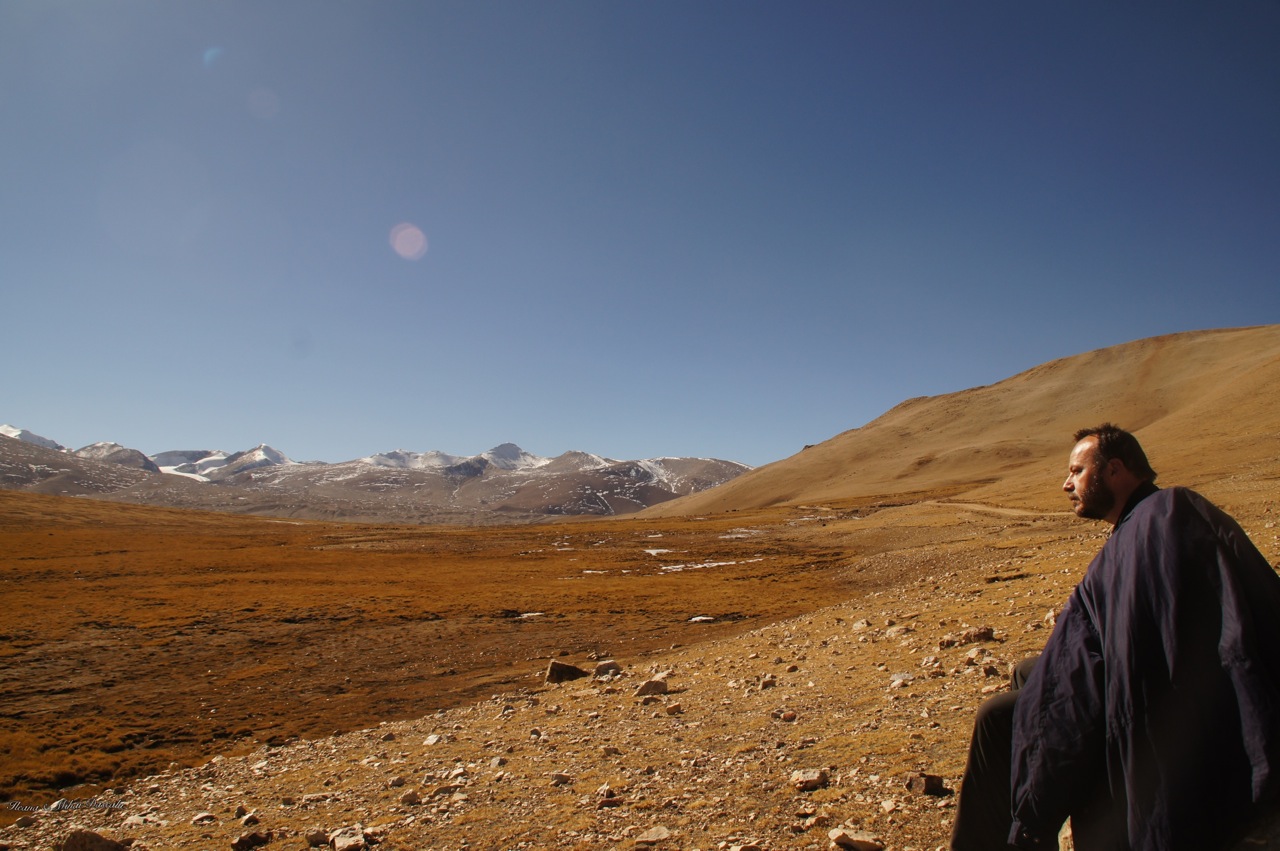
"You climbed the Everest?" asked Ileana's mother, when we called to say good morning. How could we? Only very few people do that and we are not even trekking for a couple of hours. But as I thought about this question, I realized that there is a different meaning, we didn't reach the top, we didn't even go up much, but we did climb a bit of the Everest. We were at the 5200 meters mark, on the highest mountain in the world, we had our katas with our names, flying high in the wind at the Everest base camp. It is by far the hardest thing we did in our travels, it is a very long and difficult journey. It's no small thing to reach Lhasa, and from there it is still a lot more to go.
Yamdrock Lake panorama
We left on Saturday morning, on a new highway, the road that goes to Lhasa airport. After an hour, it became just a regular sealed road. The first day it was mostly driving, first through the Kamba-la pass at 4794 meters, by the Yamdrock Lake, down at 4488 meters. It is one of the four holy lakes of Tibet and we saw how the lake retreated after some Chinese chose to disregard the Tibetan beliefs and swam and fished in it. It is a magnificent lake, a beauty, unfortunately in the cold weather it is just a very quick stop. We stopped for a minute to see our first glacier of this trip, the Kharola Glacier, at 5560 meters.

Kharola Glacier

We got to Gyantse, visited the Pelkor Chöde monastery (Baiju Temple) and took a tour of the Gyantse Kumbum, the largest stupa in Tibet, a spiral of many chapels. We didn't visit the fort, high above the city but we took pictures of it, and learned with surprise that the Tibetans are sorry that they were not conquered by the British. If they would have done that, "we might be independent now, other countries conquered by them got their independence, but with the Chinese there is no chance."

Kumbum!!!
We ended the first day of travel in Shigatse, at a brand new four star hotel, Tashi Choe Ta. Unfortunately, the heat didn't work, but we slept in freezing luxury. The second day was a quick visit to the phenomenal Ta Shi Lhun Po monastery, without our guide, she went to get the Everest pass. Then we drove for a few hours, we lunched in Lhatse, the music capital of Tibet, and kept going. Toward the end of the day we got the first glimpse of the Everest:

First sight of the Everest mountain
We spent the night in Qomo Lagma Hotel in New Tingri (Shegar). This was a two star hotel, they had electric heat, but no water and the electricity stopped at some point during the night. We were up at six, getting ready in the dark, it was a great chance to use our head-lamps. The guide was also ready but she couldn't get out of her room, the key wouldn't work, she jumped out of the window. Nobody was awake at that hour, it was really cold and really dark. What? Nobody awake at 7 am? These Tibetans must be really lazy! I don't think they are, this is another chinese gift, having to follow the Beijing time. The sunrise was around 8.30 am! We saw it in another pass, it was so cold that only three of us got out of the car. We could see the five ranges of the Himalayas, including the Everest, it was a phenomenal view and worth the early wake up time, passing through checkpoints and all the rest.

Second sight of Everest, still 80 km away, sunrise at 8.50 am

At around 10 we had some breakfast in the best quarter star restaurant anybody could imagine. The girls liked it so much, they didn't want to leave.

We would have never guessed that you can have pancakes here

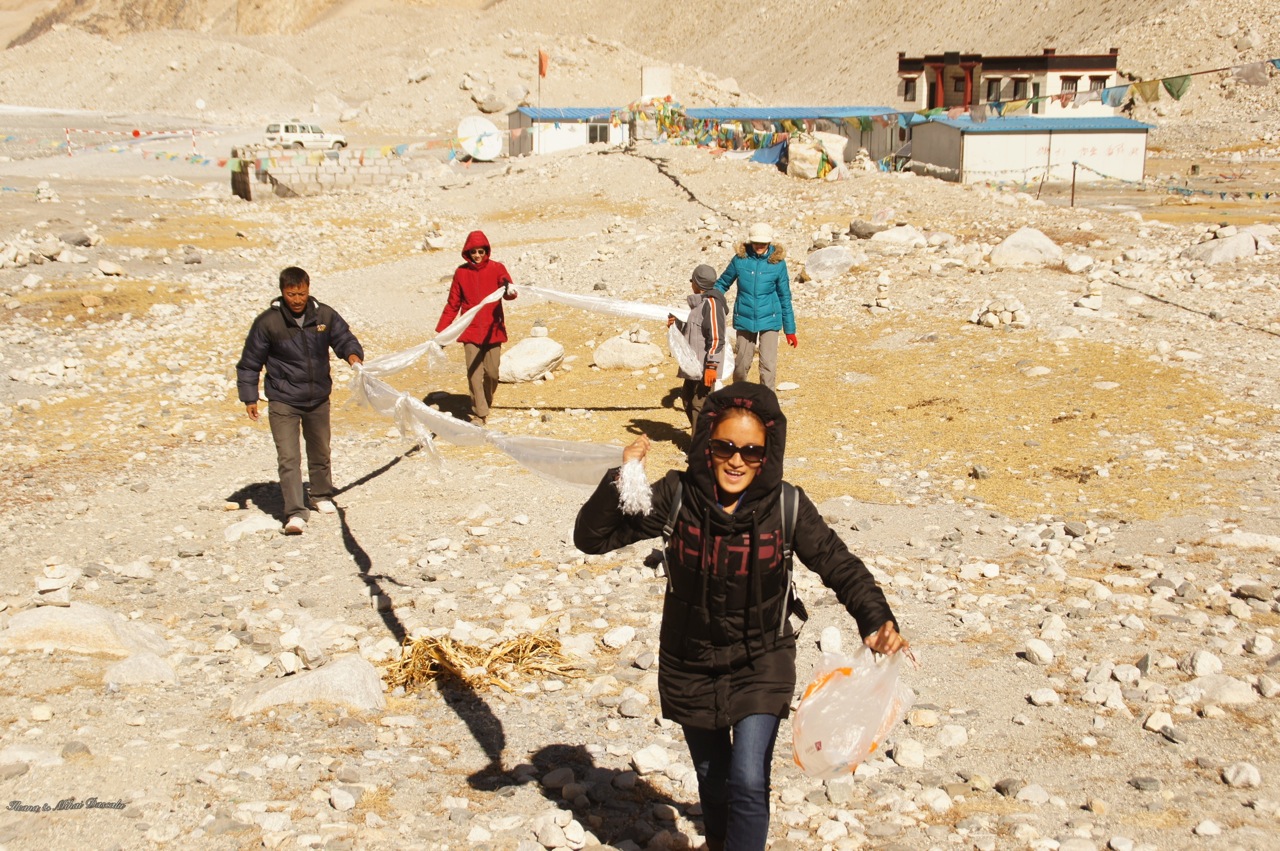
Again, getting to the Everest base camp is no small feat. It is a 102 km ride on a decent unsealed, bumpy road. Occasionally the driver would get off, on some sections of the older road, to catch a break from all the bumps. It was exhausting and it seemed it had no end. At the 94 km we arrived at Rongphu, the highest monastery in the world. A few nuns were preparing and later eating their lunch. There was nobody else around. Usually, from there, the cars can go no further and there is an ecological bus or trekking. We went with our car, past the empty tent city, up to the last barrier. The chinese military was not there. We walked past the barrier, up on a little bump. The whole top of the Everest was ahead of us, unobstructed view. It was awesome. With the expert help of our driver, we linked the katas that we got on our arrival in Lhasa and put them along to many prayer flags. The kata is a white piece of cloth, maybe similar to what people might get as a welcome to Hawaii. The wind was blowing, it was a little cold, but the sun was shining and the sky was perfectly clean. We only saw one little cloud in our 12 days in Tibet. It was by design, I chose this time of the year because of the perfect views. Other people might come in the summer months, it's warm and pleasant, but frequently cloudy, sometimes the rain would wash out the roads. I think that we were the last tourists of the year to make it to the Everest Base Cap. There was a small group of Chinese that got there an hour before us. Our guide has no more clients for the rest of the season. Most hotels and restaurants had no other customers. We spent maybe an hour around the base camp, I made two phone calls, leaving a message for my mother and having a short conversation with Ileana's mother. The signal was spotty, but in the right place it was enough. Again, she asked us if we climbed the Everest, our misunderstanding, then my reconsideration. Maybe we did climb a little of the Everest. We got as far as mere mortals do and we are proud of ourselves. Most of all we had an amazing experience that we will remember for the rest of our lives.
Rongphu Monastery and the Everest

No need to prove anything!

Carrying the katas

No comment
Never enough pictures

Unexpected reaction

Somebody can jump!!!
Returning, we took the "better" road. Hard to understand this statement. We went for many hours on some vague pass over the mountains, between valleys, sometimes on short patches on ice, sometimes through water, and all the time over bumps and bumps and bumps. We all took it well, the children laughing in the back every time they were sent up jumping to hit the ceiling.

Will we ever get somewhere?
This was the "good road" for hours and hours

God Bless You! Tashi Delek!

When we almost got to the real road we saw a tractor turned on the side in the ditch. Ileana and the driver rushed to help, there were so many people there, two infants, a miracle that nobody got hurt. Getting to Old Tingri, we were supposed to sleep in the best hotel and watch the sunset over the Everest. The hotel had no heat and no water, the people who knew how to make some electricity were gone to some meeting. The alternative was to sleep in the common room of a guest house, that would have had some fire made in the evening, but still no heat overnight. We made a tough decision to push it further. Next hotel, in Nyalam, would have heat and, of course, rooms. It was a four hour ride, most of it in the dark, after getting some nice shots of the sunset over the Everest.

Trying to get a good picture of the sunset
Arrived in Nyalam, at Snowland hotel, we got heat, communal bathrooms, and two decent three-bed rooms. By the heater, the temperature got up to 17C. Probably in the bed it was more like 12C. We slept until 9 am. Our guide came to take us for breakfast at 10, but we decided to have a brunch at the border. And so we got to Zhangmu, or in Tibetan, Dram, the little border town. Amazing, how this little town exists, one road with hundreds of trucks, houses built on the mountain, they call it the road to hell, prone to earthquakes and land slides, if something happens they are stuck without any exit. The guide and the driver made no secret that they would like to get out of there as soon as possible, but we were early for our van to Kathmandu. 

The craziest border town?
We had another decent lunch, and then passed the border by foot. The first walking border, getting through several Chinese check points, saying good bye to our driver and our guide, crossing the Friendship bridge and we were in Nepal. It was hard to say good bye to her, she was like a little part of our family, the first eight days in Lhasa but especially the next four days on the road we got to love her. We cannot thank her enough, she made our Tibet trip so special. I cannot even think how terrible it could have been with a bad guide. She was fantastic, she got really close to the children and they got close to her. Hopefully we would meet again, sometime in the future, somewhere in this world. Maybe in this life.

Kai Li Sho.

Saturday, November 26, 2011

Even Dogs Understand English

0 comments
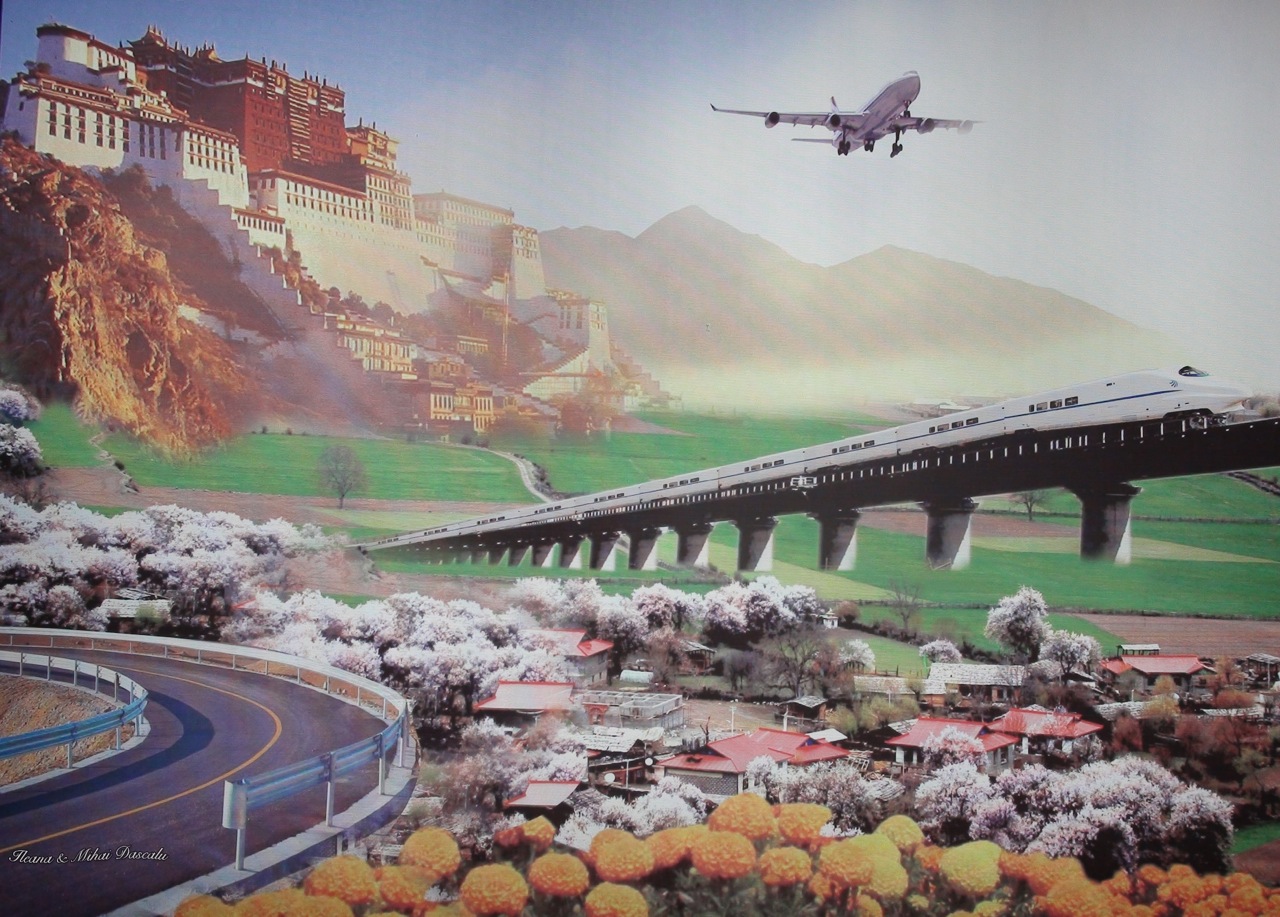
Are we in a different country? The children seem to think so, but don't ask the Chinese military and police which is well armed and guards every roof and every corner. We arrived in Tibet after more than 72 hours of not seeing any European or anybody who understands one word of English. I thought for a while of how deep the language difference is, even common sounds for pain or excitement have no similar meaning. The written language even less. But we found it funny, not frustrating, and we survived the days in Xining and the long train ride. What might have been one of the highlights of our trip around the world, was just a sorry excuse, the advertised shiny high speed train that makes the pride of China, was just a dirty, slow, loud, smelly, barely functioning concoction.
Advertisement for travel to Lhasa

The trip was made even harder by the lack of privacy and the suffering of two sick children. Ileana Ruxandra was just barely recovering and I was just starting to feel the beginning of my turn. The landscape was magnificent, but as Maria said "I watched the best of it for half an hour", theoretically there should be English announcements along the way describing the passing landmarks. There was none. The train stopped for one minute (instead of six) in a scheduled station, then for half an hour in the dessert just waiting for something. We made faces with three Tibetan children and admired the efforts of the Chinese conductor to keep the bathrooms working.
Arrived in Lhasa we were welcomed by our guide and Ileana had one first brush with the Chinese army, (they would't let her take pictures) hopefully the last one as we also learned pretty quick to ignore them. We all love our guide, it's a mandatory expense, there is no choice, but being a young, smart and funny Tibetan girl she would give us much more information and much more help then we would ever dream of. The fee for her services is $40 per day and it would be the same if she would spend every minute with us or none at all. We had a plan, suggested many months ago by an agency in Chengdu, everybody said that it is a good plan. Our 11 days here were to be spent half in Lhasa and half on the road to Nepal. After getting out for two minutes and watching five little elderly women holding hands crossing the street, I knew I wanted more. There are six worthy attractions in Lhasa, they can easily be done in three days. We cut one and did the other five one a day, took two days for recovery, and adding the arrival day, we ended up with eight days in Lhasa. We mutually agreed to speed up the trip to the border to make it in only four days. After the kids got through their sickness, I also took a day off to recover from mine. Lastly, Maria, who never gets sick (!), had a day under the weather and stayed home.


Lhasa and Tibet are sensitive and difficult subjects for travellers. We all know more or less about the issue, Americans might have heard of somebody called Dalai Lama and their president bowing and making nice to the Chinese, pretending to be strong and independent, but scheduling the visit of the Dalai Lama so it doesn't bother the Chinese "friends." Besides the pretence of independence of America, the events of 2008 when we all praised the Beijing Olympics while the Chinese army shot people in the street - what else do we know or should we know about Tibet?
Starting with the utopic story of Shangri-La, the Tibet holds a special attraction, being unique in its natural and cultural attractions. For a while there was even talk about the traveling community boycotting the Tibet, to protest the Chinese occupation, but I have no idea how much is this a present issue, and it was not a preoccupation for us as we think with our own minds.
I read a bit on different versions of history, arguments for an independent Tibet but also the Chinese version of their "liberation." I came here open minded and curious to discover what I can with my own eyes. I leave Lhasa with a clear personal conclusion that this is a different country, under occupation and probably in danger of disappearance.
People at Jokhang
On the second level of Jokhang Temple

Mandala at Sera Monastery
We chose to stay at Yak Hotel, on Beijing Boulevard, in the heart of the old Lhasa. Crossing the street, it only takes a minute to get to the Jokhang Temple and Barkhor plaza. Spending a few minutes in the street is overwhelming, it is a combination of overstimulation and altitude adjustment, so repeatedly over the first few days I got down, walked a bit and then returned to the peace and quietness of the hotel room. On Ioan's birthday we visited the Jokhang Temple, spent a lot of time there. It is phenomenal, the 1300 year old temple, with the empty chair of its ruler, "His Holiness", whose name or picture doesn't exist by China. The next day, I cancelled the program after returning tired and sick from the Nepalese Consulate. Then, one per day, we went to Sera Monastery, Potala Palace, Ganden Monastery and last, Drepung Monastery. They are all pillars of the Tibetan religion and repeatedly we could observe Tibetans exercising their beliefs, sometimes ignoring, almost walking over us, sometimes smiling and watching us curiously. At Sera Monastery, in the afternoon, we watched the monks debating. Potala Palace, now a museum of the Chinese cultural values and a World Heritage Site is another one of the most important monuments of humanity and supposedly one of the highlights of our trip around the world. As the winter palace of the Dalai Lama, it is an impressive construction, the children loved it but we were somewhat disappointed. We were lucky to have time, they fine people who stay more than an hour in the summer, but there are no tourists this time of the year. Even so, it was crowded with small, dark rooms. I did not understand why a seven year old kid who dies, being even a Dalai Lama, might need a coffin, called stupa, made of tons of gold and precious stones, especially while your people are clearly very poor, dying of hunger, constantly under threat of being occupied by the big neighbor. It made me feel a little more understanding toward Bonaparte, that French buffoon with a ridiculous sarcophage at Les Invalides. The next day, the Ganden Monastery was probably the best of all sites, mostly because we did a special kora circling the mountain. Drepung Monastery, without Maria, we saw the highlights of what used to be a 10,000 monk monastery before the "liberation." With the help of our guide, we learned about the different Buddhas, the 14 different Dalai Lamas, the different kings and Pancha Lamas, and we learned an amazing number of things about Tibetan beliefs.
Monks during debates at Sera Monastery
An evening visit in front of the Potala Palace
Approaching Ganden Monastery
During the kora of the Ganden Monastery, on the other side of the mountain
Approaching the end of the kora and getting into the Ganden Monastery
Next to Drepung Monastery

Of course, besides the religious sites, there is also the old commercial Lhasa with all the traditional commerce, and life here seems to be much like in any bazaar. The Chinese razed a big part of the old town, made a large, nice looking commercial street. Apparently, one reason was for the army to be able to intervene more efficiently, just in case. Ileana stood there and took some pictures, nobody bothered her, but she could see how the police or the army was picking on Tibetans to keep moving.

New modern commercial street
Walking just a few blocks, you get in the Chinese Lhasa, large clean boulevards, luxury stores, their people, looking and acting like the middle class Chinese of all the other cities. I have no idea who can shop in all these luxury stores, in my mind there is a planned discrimination, probably just trying to push out the old Tibetan commerce and bring in the rich Chinese.
I ended my time in Lhasa visiting alone the Tibet Museum, a couple of rooms in a huge building, a Chinese thing, obviously propaganda. I walked back to the hotel through the Chinese Lhasa, huge government buildings with soldiers guarding them, Chinese people in their own element and occasional Tibetans, lost in an unnatural decorum. I arrived in front of Potala Palace - there is a huge plaza, at the opposite end being the liberation monument. I barely took a look at it and I noted the irony, the pilgrims use the clean slates of rock for their prostrations, face to the palace, bottom toward the liberation monument. Some hip young Chinese use the monument as background for sexy pictures.

Police station being built near the Potala Palace
All over the place, Chinese military patrols. This year the main form of Tibetan protest has been self immolation, "successful" in at least eight cases, so now one of the guys in each patrol has a red hydrant, while the others have sticks or machine guns. In just a few days, I saw police stations popping up at several street corners. They were putting the walls one day, then caulking the windows, then next day they are functional with several policemen inside, next to the cage that holds 5-6 very young Chinese soldiers. I asked the guide why now, she thinks that something might be going on in East Lhasa and they are getting "ready." My first thought was that they just want the police inside for the winter, but again why now?
At Ganden, the road was in pretty good shape, but it was divided at the end, a horrible road toward the monks, littered with donkeys and stray dogs, and a perfectly good road leading to the police station, recently built above the monastery, after the events of 2008. Why do they need a police station in the middle of nowhere, on top of a mountain, with nobody around just some three hundred pitiful monks who chant all day, clean up yak butter and light candles? Why do they forbid the once a year 24 hour kora around the mountain of the Drepung Monastery? As always for the wrongdoer - the fear. And that obviously eats the victors as their victims keep going undisturbed and serene, mumbling their unending prayers. They don't care much about this life, they wait for their reincarnation and work toward their enlightenment.

How did I see the "natives"? They are certainly different then the Chinese, they look so, they dress differently, they act differently. Their religion and music, their language and writing, all come from India, nothing brings them close to China. Some are clearly on a mission, they are in Lhasa for the religious sites, doing their pilgrimage. Even the youth seems much less preoccupied by the typical youth themes. Even outside of the religious locations, people of all ages seem very religious, in a parallel world, until you catch their eyes and they start to smile. They are not really beautiful, maybe just a few of the children, they are small, short stature, slim, sometimes very, very dirty. Some are obviously very poor, but most of them seem to be just poor. Their best food might be just bad, but some dishes are plain horrible. They might be smart, but make no effort to show it. They might hold the universal truth, but at least in my impression, what they do with their lives doesn't really make sense. It is hard to understand their religion and it's manifestations. Why would people choose to prostrate all the way to Lhasa, sometimes for hundreds of miles? I would never be able to understand, but I could never imagine a harder thing for one human to do. But above everything, I felt that we were welcomed, their guests in their occupied land, they made us feel great and I think we are so lucky that we could meet a few of them. We are so thankful that we could be here. We were sick and tired, hungry and cold, but we were happy in Lhasa.

My random thoughts about Lhasa end here. Maybe we'll learn more about Tibet in the next four days, traveling to the Nepal border. So far, the same old story of the big power, conquering the little one, making up a story to justify their presence, rewriting history and then touching it up with arms, tons of propaganda and a rail line. Even if their version of history might be right, the Chinese don't belong in Tibet and they should go. But they will never go, just like the white people never left America, they put the Indians in reservations and now they let them run casinos, it seems that might be the future of the Tibetans, to provide entertainment and cultural diversity to the all mighty unstoppable Han Chinese. Is there anything left for the rest of us to do about this? A handful of visiting Russians, a family of Romanians, maybe a couple of Australians, unfortunately that is no hope. But at least in Lhasa, people watch Indian movies and try to speak English, even a dog understood and followed my directions when I asked her to join Ileana in a photo. 
With the dog that understands English

And in the last moments in our last room of the last monastery I had the impression that I might finally find the good side in the horrible smell of burned incense and yak butter. There is always hope.