Noi6 means "the 6 of us" in Romanian.

We are five, you are the sixth one.

We thank you for joining us in our trip around the world...

Showing posts with label challenge. Show all posts

Tuesday, June 2, 2026

Two years of retirement. My new job. Not that bright anymore

1 comments

I retired in May 2024. Earlier that January we decided that we will take a few years, maybe ten, to travel together to all the countries in the world. We started with two very long trips, full of energy and enthusiasm. A third round the world trip described before and a three months trip to Africa and Middle East. Then almost without pause a fourth trip around the world, a “brief” one, with Ioan and his future wife to Korea and China and then alone to Siberia, Mongolia, Belgium and Germany. It was then, on the shores of Lake Baikal that we decided to split our chores, I will travel to all the countries in the world and Ileana will stay home to take care of the important stuff…


Saturday, June 1, 2024

Two Year Report on the Road to 500

0 comments

Two years after deciding to keep track of the World Heritage Sites, here I am trying to catch up… I should have done regular updates but never got to it. The previous blogpost has been at the top of this site, promising new posts but looking abandoned. How am I supposed to fix this? I should never let this happen again… How to summarize the extraordinary places we’ve seen or the things we learned? 

Stranded on Lord Howe Island, a remote and barely accessible world heritage site in May 2023

Sunday, July 22, 2012

Tsingy and Baobabs

0 comments
Road, what does it mean? “A wide way leading from one place to another, especially one with a specially prepared surface that vehicles can use” says the dictionary. I like that part with specially prepared surface. Here is missing. We have almost 5 hours to travel to the “Parc National de Madagascar, Tsingy de Bemaraha”. The wide way is just one lane that resembles red mountains and valleys at a smaller scale. On the sides there are walls of vegetation, grass, or bushes, or young eucalyptus trees (they grow rapidly, when they are five years old, they cut them for charcoal, and from the stumps will grow new shoots). If two cars meet, one will squish itself on the side and the other will pass.

It feels like we’re training to become astronauts or we have a particular contest for fitness. In order to keep our heads not bobbing we need to move our bodies, and soon enough we feel all our muscles. After one hour we take a break, I’m so nauseous. The only relief comes when we’re passing small bridges, when all four wheels are on the same level, and for an instant we glide. It’s briefness makes it more precious. At some point there are children shoveling dust from the sides back in the holes. They are repairing the road. But every passing car, and every gust of wind sends in the air half of their work. It doesn’t matter, they wave happily.

At the entrance of a village, under a shade tree, women and children are gathered. Three women, long poles in their arms, are taking turns in pounding them in a tall tub. They are “grinding” rice. From their looks this work is back breaking. They don’t have the money to buy a machine to grind it or to pay for the electricity that it would consume.

Sunday, February 19, 2012

Beyond Fear

0 comments
I fear water! 

It is a force of nature, untamable, uncontrollable.

 I don’t like to be in deep water, to not have the bottom in reach. If I have to, I will do it, but not for fun. It is a conscious decision. So how come I am taking a SCUBA diving open water course? We’re doing it as a family, we’re taking advantage of being in Thailand where the waters are warm, 28-30 ºC. There are a huge number of schools, that makes the prices lower and also you get to choose what kind of school you want. For us is a small group, just our family (we exceed the group limit by one) and it is made possible by New Way Dive School. Anna is going to be our instructor and Sarah will join us in the diving sessions.

Friday, December 23, 2011

Write Your World (amino): India

0 comments
Write Your World (amino): India: You all are probably going to be crossing your fingers for me to get out of Goa so that you can read about monuments and cultures, but… gr...

Monday, December 19, 2011

Write Your World (amino): Fog

0 comments
Write Your World (amino): Fog: Fog is something we're somewhat familiar with. At home, there is sometimes fog on the lake. In Chitwan, Nepal, Dad and Ioan's birdwatchi...

Write Your World (amino): Schoolchildren Visiting the Museum

0 comments
Write Your World (amino): Schoolchildren Visiting the Museum: [posted late because of no internet connection in the room in Agra.] Yesterday, as we were visiting the National Museum in Delhi, we were...

Saturday, December 17, 2011

Write Your World (amino): Streets in India

0 comments
Write Your World (amino): Streets in India: Streets in India are not as crowded as I was expecting… but that doesn't mean anything. Cars, trucks, tuk-tuks, bicycles, motorcycles, and...

Thursday, December 15, 2011

Write Your World (amino): Dec 15, 2011: Streets in India

0 comments
Write Your World (amino): Dec 15, 2011: Streets in India: Streets in India are not as crowded as I was expecting… but that doesn't mean anything. Cars, trucks, tuk-tuks, bicycles, motorcycles, and...

Write Your World (amino): Dec 14, 2011: The Kumari

0 comments
Write Your World (amino): Dec 14, 2011: The Kumari: Nepali religion includes the Kumari ; aka Living Goddess. She is chosen from the young girls of the Buddhist sect born on the full moon of...

Tuesday, December 13, 2011

Write Your World (amino): Dec 13, 2011: Our 15 Minutes of Fame in India

0 comments
Write Your World (amino): Dec 13, 2011: Our 15 Minutes of Fame in India: Yesterday at Qutub Minar— a 73m tower made of red and buff-colored sandstone. Building on it started in 1199 AD. Naturally, there are...

Write Your World (amino): Dec 12, 2011: Nepali Religion

0 comments
Write Your World (amino): Dec 12, 2011: Nepali Religion: Nepal practices both Buddhism and Hinduism. Added to the enormous amounts of Hindu gods and goddesses are the Buddhas. It's hard to u...

Wednesday, November 2, 2011

Japan: People and Places

0 comments
People
It is well known that the Japanese people are polite, but I like to notice its extension.
The train conductor walks through, and before exiting, he faces the people and bows with ceremony. We try to buy subway tickets and Mihai presses the wrong button. The supervisor comes running and starts making excuses for having us waiting. In Kyoto we took the garbage out (because it was the collectin day) and later we foung just our bag opened and the garbage all over, like a car passed over it. We started cleaning up and an old lady started bowing and talking, as if saying, "I'm sorry that you had to see this." Speaking about garbage, it is collected two times a week, in small yellow bags, arranged on the sidewalk. They don't have garbage pails on the streets, and yet it is so clean.
A couple of times they stopped to ask us in English if we need help.
If you look around there is always a construction site, but it is quiet, the machines working only as long as they need to, without idling. On the sidewalk, there is a tarp so it won't get dirty. A full wheelbarrow is handled with care, and with an empty one they run, so they don't waste time. The car parked next to the construction is protected by a plastic sheet. The policeman is right there to redirect traffic, even though the space ocuppied by the workers is so small.

To enter a store you face numerous invitations, if you buy something, you are thanked countless times. I saw a person leaving a restaurant; the waiter, the cook, the maitre were next to the car, bowing, and they continued to do this until it disapeared.
The Japanese people consider it impolite to eat while walking. After buying, they either eat right there, or go for a picnic at their working place or somewhere else where they could enjoy their meal. The rule is different for drinking.
Our features betray us and everybody knows we're not from Asia. The middle school children approached us in Nara, asking permission to talk with us, presenting themselves and asking us, in English, which is our favorite food in Japan (or some boys what sports do we like). In Kamakura three boys encouraged one another to ask us for a picture together. But what amused me the most was that we were secretly photographed while we were sharing an intimate moment, happy to be in Ginza. I noticed the lens towards us and asked the lady to show me the pictures; we said farewell all smiles.
I like the children. They have school six days a week and Sunday all the sports events. They walk the streets in their school's uniforms, carring a huge backpack. They help and take care of each other. In Nara, when one of them was too fat to go through Buddha's Nostril, they pulled his hands, pushed his feet, and when he gave up, surrounded and comforted him.


Their way of dressing... for me, it has a single explanation: they are convinced that they are dressed beautifully. In Kyoto, they are encouraged to dress traditionally, and on some days the bus is free for them. If they go to the temple they get a private guide. But I think they enjoy it, it is a special event, a preparation, a state of being, a belonging, because I've seen them not just in Kyoto, but in Tokyo, in Nara and Kamakura. And not just women, but men also, dressed in work clothes or ceremony ones. On two ocassions I saw children, but I presume it was religion-related.


Visiting temples, I noticed that they have special rooms for resting, eating lunch, and where they offer you tea. In one of them, even if the room was full of people from different groups, it was quiet and a pleasant atmosphere.
Family: dads looked comfortable changing the diapers (in public) and handling the stroller or an upset child. There were many pregnant women or with infants. The grandparents are present in everyday's life. Everybody has a slow relationship with the child: they wait for him to understand what he sees, to accept an interdiction, they go down to his level, make eye contact and slowly pick him up like he is a fragile treasure.
Men in suits: are everywhere, at every hour, of all ages. I met them on their breaks, evidently, while smoking or gathered around a cup of something, or in the subway. Their shirts and trousers are a few sizes bigger, like this will help them not feel constrained. Even their shoes are bigger and that changes the way they walk (the same is true for women). While in the subway or the train they sleep seated or standing and, through an unknown technique, they awaken in time to get out where they need to go.
I saw homeless people surrounded by many bags. In the subway, an Indian without a shirt was explaining in English and Japanese that he doesn't have money, and the policemen were inviting without touching him (for 5 minutes) to enter the supervisor's office. There were no beggars!
Our host Mink told us that on the sidewalks narrower than 3 yards the bicycle people should walk, but they just slow down and they follow you until they find a space to pass you (on your right).
There are two reasons for not writting about shopping: first I don't like it, and second we didn't go. It is wonderful to walk the streets, passing stores, knowing that you don't want to, don't have to and don't need to buy something. But the Japanese people buy and after using them, or when they don't need them anymore, they sell them second hand (or n-th hand.)
I knew about Japanese from books and movies, that they are hardworking and polite. It was a pleasure to observe them as a traveler.


Places
Museo d'arte Ghibli: it is a place for people of all ages, appreciated at its true value by the older ones. Hayao Miazaki made several full feature movies and the majority had international success also. Personally, I especially liked Totoro, Spirited Away, Howl's Moving Castle, Kiki's Delivery Service and Ponyo. I cried with bitter tears at Grave of the Fireflies, a movie about the effect of WWII on two siblings. The museum presents the way his ideas transform into a movie. It is a building with an eye for detail and for the child, in which characters from his movies can be found in little spaces, in lamps, windows, handrails. There are small houses with doors that you can open and see a scene from a movie, there are two cat-buses (from Totoro): one for adults, wrapped in artificial fur and soft on his head and paws, and one for little children, soft all over. There is a theater with 70 seats in which twice this many people watched a 15 minute cartoon about preschool children playing (everything was in Japanese, but we got the idea). There are rooms with walls covered in drawings and watercolors, with Mr. Miyazaki's desk, with the plane model from Porco Rosso and big jars completely full of used pencils. In a different room you could see how the animators transfer the drawing onto celluloid, a moving sequence, color samples, how they cut and paste. On the building's roof there is a garden with plants specific for the area, and a robot like the one from Castle in the Sky, in front of which there was a long line to take your picture with it. To all of this, you add a courtyard with a water pump, a terrace and the store Mama Ajuto (Mom, Help) where there was a step-on-toes mob. The museum was brimming with children and their parents, and we were the most childish of them all.

Kamakura: an hour and something away from Tokyo and we had to change several trains to get there. You have mountain and ocean in the same place. We went trailing on the hills, through the woods, we had a picnic at the statue of the first shogun of Japan, we saw a big statue of Buddha outside (they tried building something overhead but everytime it was destroyed, so they presumed that he likes it al fresco), we went to say hello to the Pacific Ocean from this side, visited a temple and went home. The weather started off sunny, then changed different clouds and ended with a steady rain, but for us was a wonderful day because we were with our friends Ana (Anna) and  Doru (Dorhu), and their children, Rares (Rharhesh) and Dara (Dharah).

I liked Tokyo: modern architecture, space, parks. We visited The National Art Center, Mori Art Museum and Tokyo National Museum. We saw Ginza, Ueno, Roppongi, Shinjuku and the busiest street-cross in the world in Shibuya. We entered The Imperial Garden and Shinjuku park. We saw open-air exhibitions of art with windmills and Guliver's Table. We marched beside a protest against nukes. We ate the food that enticed us (seaweed at the fish market) and we liked it.


Japan was everything that we imagined and much more, and we'll see more of it next time. Tomorow... Beijing.
I am in the airplane taking photos of Tokyo International Airport. I look down and see the three men who signaled the airplane on the tarmac bowing deeply toward us. In my heart I bow to them.
Sayonara!

Tuesday, October 25, 2011

Buddha's Nostril

0 comments
Today we went to Nara. We bought tickets, we entered the station, found a conductor and asked him, through signs and Japanglish, which train should we take. I've learned Japanese once a week for three years almost twenty years ago and never practised since then. For the first days here I was almost lost. Beside thank you, good bye and excuse me everything seemed a long sound. After a week here I can recognize names of the stations and some other words that were long forgotten.

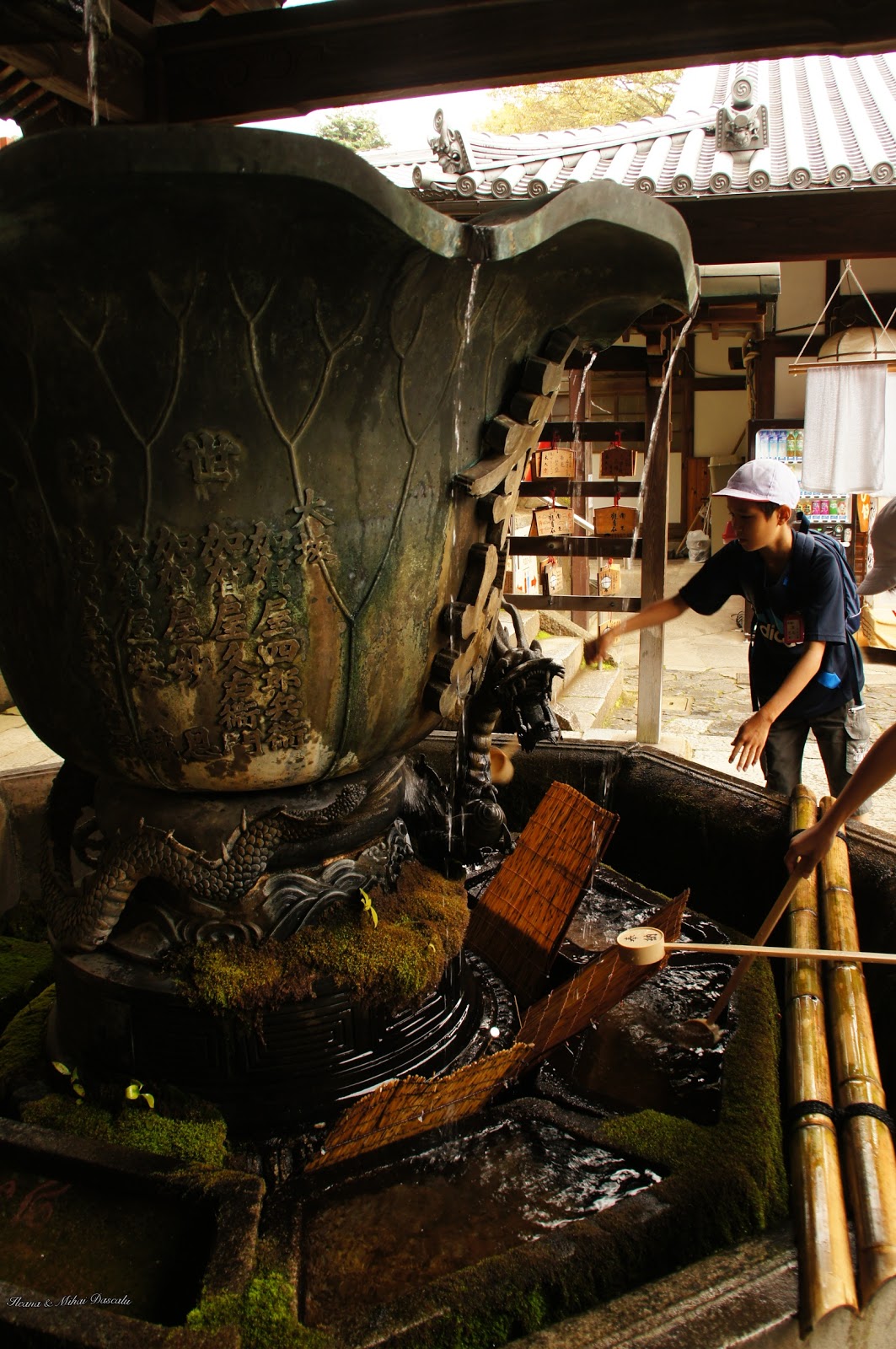
It is surreal traveling, being here, but separated. Everything is written in Japanese and in the important part something in English. It feels comfortable to find something that I can understand. Not being able to read eliberates me to observe. I may not know the semnification of the differences in the positions of Buddha, but I can see the people. They come looking around themselves, looking at the leaves that just start to turn reddish. At the water fountain they fill the cup with water and wash their left hand, and then the right one, and then they fill it for the third time to wash the handle, so the next person will have a clean cup to wash their troubles.
Nara


They walk and talk, buy their incense or their prayer that is written on a piece of wood tied with a red string. Or they write it on a piece of paper that they fold and tie it on a tree or a special stand.


Kiyomizu-dera Temple, Kyoto
At some temples they bow and as they say their wish they ring a bell, and throw some money in the big box, or they clap their hands, bow again and then continue their life. I like to see them in that moment of devotion.

I have to remind ourselves that these lovely gardens and pavilions are temples.

Kyoto- Golden Pavilion
 A week ago I was in JFK thirsting for a tree, even a fake one, or for some form of vegetation, and now I'm surrounded by little hills with streams that gather in ponds with colored fish. In the begginings the Japanese were animists and even when they adopted Buddhism they still believed in spirits in every form of life. They work every day to transform nature; they prune the fir trees needle by needle, make hedges from camelias. They sweep the leaves that have fallen during the night (imagine a leaf-blower in a temple).

But beyond words and language, we are here for the same reason: to admire... nature, patience, work, people, imagination, vision.


The largest wood building contains a seated Buddha. He sits on a lotus flower and every petal is inscribed with the same story of how things are inter-related and they affect each other in thousands ways.


 Behind Buddha there is a single tree column (as there are the others in the temple) and at its base is a hole the same dimensions as Buddha’s nostril. There was a long line of school children waiting to go through and our children joined them. It is said that if you manage to get through, you will reach enlightenment.