Noi6 means "the 6 of us" in Romanian.

We are five, you are the sixth one.

We thank you for joining us in our trip around the world...

Showing posts with label India. Show all posts

Tuesday, August 28, 2012

F'ailte gu Alba!

0 comments


Ciamar a tha thu! (keh-mer a ha-oo) It means how are you in Gaelic. And the title translates as “Welcome to Scotland” but I don’t know how to pronounce it.


Thistle, the national flower.

We’re not six anymore, we’re just four, because the girls are in USA. Dubai-London, London-Edinburgh, a bus, a train and a car ride later we’re in Valerie’s bed-n-breakfast where we drink tea and chat. Apparently 18 C is a tropical weather for Scotland, too hot.

Monday, August 20, 2012

Dubai

0 comments

Emirate Airlines is the best by many standards (by mine it is second, after Air Madagascar). We watch movies continuously just because we missed them and we don’t want to think what’s coming after we get in Dubai. Our girls travel by themselves back to the States for 10 days. As a homeschooling mother I have them under my sight most of the time, and as a traveling parent 24 hours a day with little exceptions. It is time to cut my umbilical cord and learn to live without supervising them.

We say our good-byes and hug and kiss. They go their way, to catch a transfer, we go ours, to customs. We wait in line and I observe: only men work, dressed in their white robes and spend most of the time rearranging their head-scarves. Some military marches from time to time, but everything is smooth and efficient, we get stamps in our passports: Salaam Dubai! (Sahl-aah-m) Hello!

We wake up around noon after 6 hours of sleep and at 4 we take the free shuttle to some mall from where we can take the subway to get to the tallest building in the world Burj Khalifa. As we enter the mall I notice a sign:

Friday, August 17, 2012

Journal of a Nomad through Vasteland (4)

0 comments

August 11  

We packed our bags and went to an Ostrich Farm to have a tour. We had to wait for 11 o’clock, and perused the shop. They had simple eggs, decorated, painted, sculpted, transformed in lamp shades. Beside this, feathered dusters, feathered snakes and all sorts of things made from the ostrich skin (it looks geometrically bumpy). Needless to say everything was so expensive. On the grounds there was an old round school that housed the names of people who donated for the new school. We found three Romanians and one guy who was from the country Texas (sic!).

What we learned about ostrich farms: they started in 1800’s because the fashion of that time required fluffy feathers. At some point they sold one ostrich feather for its weight in gold. The “feather barons” built themselves beautiful houses, including a pool for 15 people, but that was never used (it would require the water supply for a year). When the fashion changed there was a slum, but they changed too—now they are growing them for meat. Ostriches are not bright, they have only 40 grams of brain, so any enriching program failed. They go for their fellows’ backs, pecking their feathers off. 

The highlight of the visit was riding ostriches (same as Moco in "Two Years of Vacation" by Jules Verne). Mihai and myself got to mount one (we’re overweight by ostrich-riding rules). The bird had its chest in a V-stall, and a man was holding it in there from behind. The back was wide, and warm. I petted its neck, it had a warm snake feeling, it was awesome. The children had a blast! It was very close to rain, and there were other people with children, but for some reason the guide took a like to us and invited our children first, before rain started. They were supposed to climb on the bird’s back, hold onto the wings, cross their ankles at the front. A guy would take off the bag that covered the ostrich’s head and start yelling, and another one would hold my child from behind so s/he would not fall. The bird would start running around and all the others, slowing themselves down. Ileana was laughing, happy, no constraints. Ioan too. Maria was still waiting for the exciting part to start, she felt comfortable as on a horse.


Saturday, May 26, 2012

Nothing Beats Cold Fried Fish For Breakfast

0 comments
We left Australia a couple of weeks ago, but I still refer quite often to that book, "We of the Never Never". It doesn't help that Ileana is now reading it and she often finds something interesting to share. So it comes easy for me to say this morning "nothing beats cold fried fish for breakfast!" Actually is not bad at all, we get interrupted a moment later, a waiter delivers five plates of dessert, banana fritters with grated cheese and some cookie with nuts and chocolate. We are confused but later learn that we have two breakfasts this morning. The first is an "all you can eat buffet" with eggs, cereals, bread and croissants, plus fried fish, sausages and a couple of sorts of rice and the second "light breakfast" with the above mentioned cookies. I enjoy every moment of it, hoping that they wouldn't kick me out at 10 am. I have no idea what time it is and I don't want to find out. It is 8.10 am (thank you, Maria) and our day is almost over! I would linger in the garden for another hour and then go back to bed.

The Temple of Borobudur, May 2012

Monday, January 23, 2012

Welcome, Day 100!

0 comments

It's here! Our 100th day on the road. We left October 16th, and now it's January 23rd.

That said, it's been nuts. We've been all over the place (so far: Japan, China, Tibet, Nepal, and India), heard all sorts of languages, and walked probably more than is healthy. 

Just joking. You can never walk too much.

So, what am I doing to celebrate our 100th day? Writing this blog post, full of small snippets of our life over the past hundred days.


Before I begin, though, something Melly, a friend from the Write Write And Write group, said before we left:

Wednesday, January 18, 2012

Driving in India

0 comments
First things first: they drive on the other side! It is a British inheritance and at the beginning you have to think twice and mirrored. You use to change gears with your right now you have to do it with your left. But after a while you get used to it, and it is easier.
Old Goa.

Close to Humayun's Tomb
The road means a special area designated for traffic. It is a way to move from one place to another. You can find exceptional highways, with lanes and shoulders. On the billboards you can read: “It is safe to drive in lanes” and most of the cars will try to stay between those white lines. But not everyone, you will find some tuk-tuk driver who decides that he had enough, and will try to squeeze, honking left and right. And while you are beeing driven and thinking how nice it is, the traffic slows down and you realize that is an Indian’s sleeping policeman (a speed bump). These are very efficient, and so frequent that you can never go over limit (not that we’ve seen one).
There are other kind of roads. The ones with potholes and crumbling blacktop. Or without blacktop.


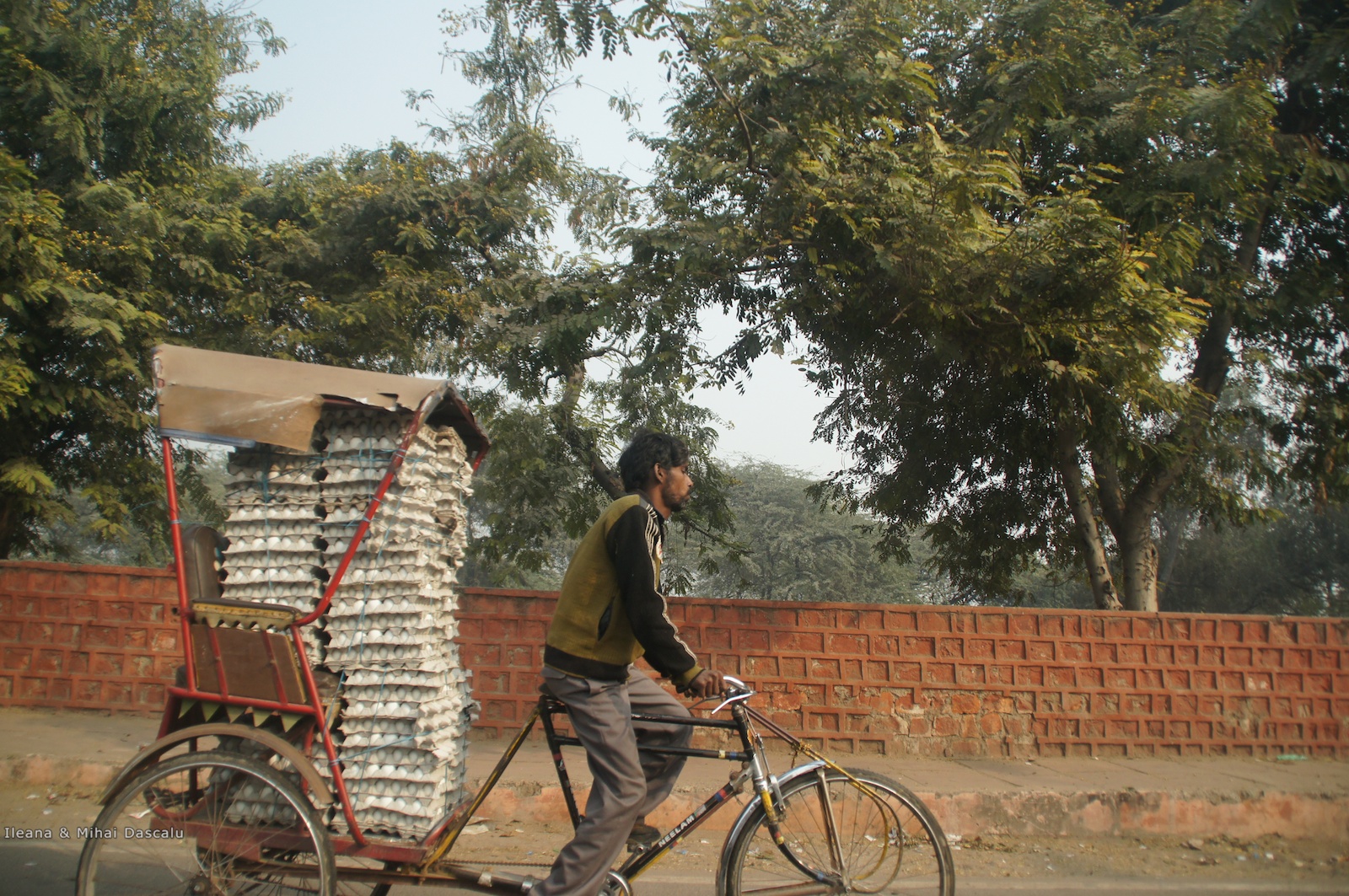
These are busy most of the times. In the city you can find cars, buses, trucks, motorcycles, tuk-tuks, bicycles and cows all in the same time, in a very small space.
Agra, going to Taj Mahal.

 And guess who has the right of the way?...Come on....Yes, the cow! She will walk slowly toward the next pile of garbage. After her, it’s the biggest: bus trumps truck, truck trumps car, this one trumps rickshaw. Or the swiftest: the car. Why not the motorcycle? The drivers go slowly. They are the only ones wearing a helmet, if they are wearing, and behind them there are two more people, either two men or a child and a woman dressed in saree, sitting sidesaddle.

A child, a man, a goat and an old woman.
You already know that everyone honks, and on the majority of vehicles is written “Please sound horn.” Like the French policeman’s whistle, the horn is a language in itself. “I’m right behind you/ I want to pass you” and the other car honks back, saying it’s OK. “I’m already passing you, move to your left! Everybody, pay attention. Just stay there and don’t cross.” I’m sure you can find your own translations. I think they like honking. There were lots of cars and motorcycles waiting for the traffic light to change. One driver waves us to cross the street, and we do that in a hurry (you never know) and by the time that we were on the other side they started honking like we were the ones holding them there. Go figure!
Red Fort, Delhi.
The traveling books are recommending you to hire a car with a driver, because he knows the roads, and the language, and is used to drive on the other side. Sometimes he is a calm person, who will wait for opportunities to pass another fellow driver. Sometimes not, and you have a lot of honking, you see the incoming traffic getting closer and closer, you start cringing and lean to your left, like you could make the car be slimmer, you hold your breath and pray to God not to have an accident, but still have your eyes open. When you see that you are alive, you rewind that last second and realize that everybody made room by moving on the sides. And you start breathing again, until the next time.

Kerala, Vypeen Island.
The traffic follows other rules, not the ones that you know, the most frequent one being not to stop. As long as you are moving, you are OK. You have to be quick in judging the situation and position yourself behind other moving cars, that are not likely to stop (because signaling was never heard of). If there is no incoming traffic, the whole street will become one way, the faster passing the slower. An incoming motorcycle will still be pushed on the side, everything going back to normal only for a truck or a bus. The last ones will stop, but only for a short time, so you have to be quick, jump on to it, and move fast so the other people from behind could get on.
 In Delhi, where it was around 60 F, I could never understand why would the Indians insist on open windows. In Goa, at 100 F, I got my answer: if we were not moving, the air would not move, and we would feel the sweat trickling down on various body parts. Maybe they just like fresh air!
Buses come in all sizes and shapes. The cheapest is the “metro feeder” the one that transports people to and from bus station and subway. It looks like is going to die any second now, old, battered, with grates outside of windows, and with benches that could accommodate two children. The other ones are better looking and some have air-conditioning (these are expensive). 
The drivers embellish them with signs of their religion: pictures of Hindu gods, prayer wheels, crosses, something written in Arabic, all with a wreath of flowers around them. One bus had all of them. 

Christmas is coming!

Bus in Goa.

In Kochi they have names, like “Success” or “Vijey.”
In Fort Cochi

Bus in Goa
In Goa cars have under the front bumper a lemon stringed with a few chillies.
The tuk-tuks, or rickshaws are fun to be in. They don’t go over 30 miles/hour so you have time to notice things. They too are decorated with hearts or tassels, even on the wheel. Some have rolled up doors, in case it’s raining. Up to 12 people, including the driver, can be transported inside, but I can’t understand how.

On the cart there is a huge metal pipe and the motorcycle carries a window pane and a big piece of plywood.

We hired cars with drivers, because for us it would have been too much stress. The drivers didn't know all the roads, and though there were big signs telling them which way to go, and we had the map on iPhone, they would still pull on one side to ask for directions from their fellow countrymen.

Would you drive in India?

Monday, January 16, 2012

India, My Love

1 comments

“How long do we want to stay in India?” We didn’t know. Two weeks to visit the Golden Triangle seemed too little, but could we last five weeks?

Qutub Minar, Delhi
  The signals from different people that we know, who visited India, were mixed. My gut was telling me to choose the latter.

India, take two

0 comments

There are occasional good moments on a trip like this


Maria turned 17 in Agra

There were some moments when something clicked and some insidious, indescribable change that happened during our five weeks of India. After getting almost sick to see the misery of Old Delhi, things got only better. There was misery in Agra and a glimpse or two during the rest of our trip. There were the eyes of my son and the younger girl who was begging to take his chips from his hand. The lady who stood next to us for several hours on the ground in the Agra station. It was her home, there, on a piece of plastic with two bags around her. And maybe a few more images. 

I didn't discover the magic of India. I did not get enlightened or amazed or reborn. Slowly, things that were incomprehensible when we arrived, started to make sense and a while later I didn't remember if there is any other way. 

Sunday, January 15, 2012

Fort Cochin

2 comments
The corporation of Kochi, or simply known, Kochi, is the biggest city in Kerala, with a population of about 1.5 million people. It was created by joining three communities, Ernakulam, on the subcontinent being the modern one, Mattuchery and Fort Cochin on the island being the older, touristic and tranquil places. Our choice was Fort Cochin, another UNESCO World Heritage Site. It has a Portuguese history, a Dutch one, a royal one and now it is at the forefront of the tourism development in Kerala. We stayed at Orion Skywings, a simple, but good mini hotel, the cheapest so far. We saw the historic attractions in Mattuchery, the Dutch house and the old Synagogue. No pictures allowed, but we got to pay Indian prices, 5 ruppees! The Dutch house has some amazing wall pictures, very old and interesting depictions of Mahabharata and besides that has a good, educative history of the royal family and traditions of Kerala. The head of their royal family was still alive when they put the exhibition together. He was 93 and he worked as an accountant after India's independence. Remember Mysore?
I visited my first synagogue, mixed impressions, they only have nine Jews left in the state, it takes ten for a service, I don't get it. Everybody said we should visit and having it there and a few hundred years old, we visited and it was interesting. I think Mattuchery is a brief stop on the itinerary of some cruises, there were a lot of groups of western tourists. The highlight of the day was the restaurant Casa Maria, where Ileana Ruxandra had the "best Indian meal" then the trip back to the hotel with the singing driver.


Another attraction in Kochi is the "Chinese fishing nets." Ingenious mechanism that takes six people working together, they were up, nothing was going on. It was a strong current that day, we got contradictory information about when to return. I wouldn't pay 200 rupees, $4, for a mock demonstration. When people see the true thing they also buy some of the catch and take it for cooking at one of the local restaurants.
Resting Chinese fishing nets
It was 8.30 am, we heard about a beach, we didn't know much. We jumped on a ferry for a quick trip, later I will find out that the ticket guy took three times more money from me. I gave him a hundred he probably got tired of counting the rest and stopped after giving me 70. How much was one ticket? Then we took a wrong road, ended nowhere, came back and took a 45 minute ricksha ride. We had no idea that it would take this long, we had almost no money and no food.
We arrived at Cherai beach, on Vypeen Island. This is phenomenal, the perfect beach we've been dreaming of. Ten kilometers of uninterrupted, undeveloped, sandy beach. Hardly any people. Unfortunately, no cows. After a few hours in the sun, we took of to walk for a bit and left the children by themselves.
Cherai Beach

When we came back an hour later, they were visited by "a beautiful, funny, young Parisian," who invited them to her restaurant. It turns out that Marjorie and her two partners just opened "Les Trois Elephants", a luxury resort. Maria gave more details here. We were so tempted to stay for our last night in India, and they would have given us a discount, but things didn't work out. We had a great lunch, French cuisine, including one dish of crème caramel. This is the kind of place where people would come after crossing half the world and have an amazing vacation, then go back recharged to work for another year. We will remember it for a long time, even though we might never make it here again. If you come in this area schedule a few extra days, go the "The Three Elephants" for us and say hello!

With Marjorie at the resort "Les 3 elephants" 

One of the rooms

The children learn a new game

Back at our hotel in Kochi, we have the last 48 hours of India. We look for tickets for a kathakali show, this is a famous traditional dance form. We write postcards and we do a quick tour of the old churches. It is impressive to see the first tomb of Vasco Da Gama. Of course his remains were moved to Portugal, but just imagine, he died here almost 500 years ago!

Sending postcards from India

St. Francis church, the temporary resting place for Vasco da Gama

In front of Santa Cruz basilica
 The Greenix village is one of those projects that you have to admire and respect. Combining money with a good cause and making what seems to be a self sustainable art venture. We saw the Kerala Cultural Experience, a 90 minute show of traditional dance forms from this area. It also included a little number of martial arts, even our black-belted children were impressed. We ate twice at their restaurant trying various local dishes. We liked them and they liked us!
End of show, the guests are invited for pictures

With the people at the Greenix Village restaurant

The last day came. In the morning, the children left at the hotel, we went to the Sunday mass at a Syrian orthodox church. We stayed for almost the whole service, women on the right, men on the left, a big nice church with open walls, loud megaphones and good choir. We couldn't understand one word, it was all in their impossible Malayalam language, I even recorded a segment for posterity.
At noon, we struggled to find a restaurant open for lunch, when we came back the taxi was already waiting. Seventy five minutes later, after a ride through the up-rising Ernakulam, we were at the airport. This is the first airport in India that was built with some private money, it is sparkling clean, super-modern and almost empty.
And then we left India. So many experiences, so much learning and in the end an unfinished business. While we saw the most important things in Japan and pretty much all there's to see for us in (upper) China, Tibet, Nepal, Delhi and Agra, now I felt that we were only skimming the surface of what this country has to offer and we will have to come back over and over and over.
For me, it was a continuous crescendo and I liked it more and more and more everyday. I will let my thoughts settle for a while and return at some point to what I learned in India.

Friday, January 13, 2012

Kerala, God's Own Country

1 comments
In the Southern part of India there are two special states. To the East is Tamil Nadu and to the west is Kerala. Tamil Nadu, two times more people, four times bigger, is drenched in history and has lots of attractions, but we chose for this trip the smaller, much quieter, Kerala (pronounced Kerla). It's nickname is "God's own country" - even the pilot on our flight used that. Two thousands years ago Apostle Thomas brought Christianism here, following in the footsteps of Phoenicians and Romans who traded gold for Kerala spices. To this day Kerala still makes the best pepper in the world. We chose to come here for a couple of reasons, one being the cheap flight to Kuala Lumpur. When I bought the tickets we had no plans for India and this option opened a lot of choices.
Kerala was a newly formed state after India's independence and it's mostly populated by Malayalams. Their language is the most amazing, impossible to describe or understand thing that I've ever heard. It's rolling sounds made us stare in disbelief when our driver took a phone call.
Kerala holds the questionable honor of being the first place in the world where communists won in democratic elections. They remained in power, more or less, over the last 54 years. Maybe because of that there is more equitable distribution of land and wealth and Kerala has impressive records in health and education statistics. Considering our allergy to communism, we might have had a problem with that in the past, but truly is any political party (anywhere in this world) good for anything? At best they might be the promoters of some doctrine (by definition no doctrine has any good value in real life). In the worst case scenario, and unfortunately much more common, a political party is a mere facade to give legitimacy to a clique of opportunists and power grabbers. So communists or not, we arrived in Kerala, even if that might have cost us our lives. We didn't know the price at the beginning and we had a good laugh when we found out.
The North Canal in Alleppey
We landed in Kochi and we decided on the side walk of the airport to give up our plans for the southernmost point of India. We took a cab to Alappuzha and for almost three hours we were in heavy traffic. I used the time to call for accommodations and we found a "family room" at Tharavad Heritage. That turned out to be a full apartment with seven beds, but we needed air conditioning and that was only available in the two bedrooms. The air was very humid, it was hot and actually unpleasant.
Alappuzha (or Alleppey) is a city of some 200,000 people, 60 km south of Kochi. It is nicknamed the "Venice of Asia" - I hope that was never more than a joke. It is the main point of entry to the Kerala backwaters, a network of some 900 km of canals that has been in use for thousands of years and a major touristic attraction of Southern India. There are several ways to visit the canals, one being by houseboat, other by organized tours - several hours to a full day, or even just by regular ferry. We dedicated one day of shopping for the best option, but our search was done in five minutes. Our hotel had a luxury boat with two bedrooms, purchased six months ago, and they were giving us a very good price because we were already their clients. The children were attracted by the option of spending one night on the boat, the parents were excited by the opportunity of a more intimate exploration of the backwaters' way of life.
Before I quit my job, my coworkers gave me a good bye party and collected money for a gift. I asked them to donate all of that to the children's "fun fund", and the luxury houseboat fit the price and the goal. So we used their money and had a fabulous experience. Thank you so much!
********
The search for a boat done, the temperature and humidity too bad, we choose to spend most of the day inside. The children do school for many hours. We leave at four, walk to the beach and have a good couple of hours on the seaside. The Arabian Sea is warm but agitated, only Ileana and Ioan, the youngest ones, have the energy to get in the water. We catch a nice sunset and have dinner at a good restaurant.

Ileana and Ioan playing in the waves 
Sunset, Arabian Sea

Next day, the biggest and best tuk-tuk would take all of us and all our luggage for the ten minute trip on the other side of Alleppey, where the boats are. We have a glimpse at the city life, pass by canals, no, this is not Venice. A tiny harbor holds countless boats, moored in several rows. Of course ours is the finest, easily recognizable, it has an observation deck on top. We are welcomed by the three man team and immediately served a fresh coconut. The best one so far, it has a lot of juice. They bring bananas and a pineapple, the lunch would be served later. We travel along a canal for a few minutes, then we enter the largest lake in India, cross part of it and we get lost along small canals. We lay up on the observation deck taking innumerable pictures. Ioan gets to drive the boat and has a good talk with the captain while the girls are working on their projects on the lower deck. The captain offers us the choice of going to the market to choose our own fish, but we would rather have what they give us for lunch. When it comes, it is a mirific display of traditional Indian cuisine, along with five fried black Kerala fish. I especially liked the pineapple curry with grated coconut. All the dishes are very tasteful and we enjoy it tremendously. The boat is anchored by a palm tree on the edge of a rice field. After the lunch break, we resume our journey along canals, passing by villages, waiting for a canoe with schoolchildren to clear our way, watching people coming out of church, washing their clothes, working their crops. It is so peaceful and nice, it is complete relaxation on the beautiful Kerala waters. At night we pool by the side, along with some other boats and have a great dinner before playing cards games and retiring for the night. In the morning we catch the first glimpse of the sunrise coming through our window. The boat starts the return journey while we have our breakfast and we are back in port by nine.

Welcome drink
Boat at rest, lunch break
Lunch on the boat

Images on the side

Drinking filtered water, resting on the observation deck

Sunrise in Kerala

Getting ready for the return trip


Of course there is another way to look at things and the whole paragraph could be rewritten. While you want to see your boat before paying for it, there are no good or bad choices of houseboats. There are hundreds and hundreds of identical boats, leaving the port all at once, following each other on some canals where nothing happens. After the first few minutes, when the initial excitement wears off, the boredom settles in. The schedule is made of lunch and dinner. The crew knows minimal English, and there is no program of visiting any traditional village, spice plantation or other attraction. There is no fishing or swimming. When we ask, we cannot be understood, or at best we get a "no problem", standard answer. The unlimited refreshments for the children are missing, they eventually find a small bottle of Pepsi somewhere. When they cut the pineapple, half it's lost, and we only eat two meager quarter slices. Since I didn't get any discount on the boat, I was promised two bottles of beer, free, and they would materialize after my specific request at dinner. The amazing Indian food is clearly not by our taste, it's all too hot and after a couple of bites, you cannot feel the taste or the mouth or both. And I really prefer the basmati rice to the Kerala one. Getting frustrated with the boring ride down similar canals, we cannot wait to move our feet.
The cohort of houseboats taking on

A very nice way to cut the pineapple, we never figured out what happened to the other half
When the boat stops for the night we take the path by the water, eager to explore. The canals were filled with communist flags advertising the next party congress and where we stop there is a loud political propaganda playing on the megaphones. Even in a foreign language it is so disturbing that we turn toward the rice fields and walk for half an hour toward some music. We get a glimpse at the sun setting, but cannot really see it because of some houses. Ileana gets chased by a crazy cow. When we decide to return, Maria discovers the fresh shed skin of a snake. It is about 2 meters long and the family picks it up for pictures. It is still moist and it wasn't there when we first passed. As we get closer to the water a local comes to warns us that we shouldn't be on that path, there are huge venomous snakes, very dangerous. Sorry, you shouldn't have put the communist propaganda on, we were just trying to get away from that. We laugh it off without thinking for more than a moment that we were so lucky, one of us could have been the daftest communist victim in the history of the world.
Another common sight on the side of the road
My family with the snake skin
Taller than Maria - maybe 1.70cm

Meh, I really prefer the first description of our trip, it was a fantastic day, we loved it and we thank my friends and former coworkers for their generous gift, and my kids for wanting and demanding it!
Good bye picture with the crew. Thank you! It was great!